.png)
Do I Need Planning Permission for a Loft Conversion in Bournemouth? (2026 Guide)
Starting a build without a Lawful Development Certificate in a Bournemouth conservation area like Talbot Woods is a gamble that could cost you far more than the £548 planning application fee. You've likely spent hours wondering, do i need planning permission for a loft conversion, only to find conflicting advice about Permitted Development and BCP Council's unified 2026 local plan. It's a common frustration for Dorset homeowners who want to expand their living space without the stress of legal setbacks or the fear of being forced to tear down a build. We believe in building excellence. This commitment begins with meticulous planning and professional integrity.
This guide provides the reassurance you need by detailing exactly when you can legally bypass full planning and when local constraints require formal approval. We'll examine the 50 cubic metre volume limits for semi-detached homes, the impact of the 3.8% fee increase that took effect on April 1, 2026, and the mandatory nature of building regulations. You'll gain a clear framework to protect your property and ensure your bespoke renovation is fully compliant from inception to completion. By understanding these local regulations, you can move forward with the quiet confidence that your investment is secure and your new space is built to last.
Key Takeaways
Master the nuances of Permitted Development to achieve a faster project timeline without compromising on the quality or structural integrity of your build.
Determine if your property falls under BCP Council’s Article 4 Directions, which can mandate a full planning application even for modest residential improvements.
Navigate the specific height and volume restrictions that dictate exactly when you do i need planning permission for a loft conversion in the Bournemouth area.
Establish a clear path toward obtaining a Lawful Development Certificate to provide absolute peace of mind for both you and future property buyers.
Table of Contents Understanding Permitted Development for Loft Conversions in 2026 The 2026 Criteria: When Full Planning Permission is Mandatory Local Constraints: Bournemouth, Poole, and Dorset Specifics Securing Your Investment: Lawful Development Certificates
Understanding Permitted Development for Loft Conversions in 2026
Permitted Development is a national grant of planning rights that allows for loft extensions without a full planning application, provided specific criteria are met. This system acts as an implied grant of permission for various house improvements, allowing you to move forward with your project with greater speed and certainty. For many homeowners in Dorset, this is the most efficient route to creating a bespoke new living space. When you ask yourself, do i need planning permission for a loft conversion, the answer often lies in whether your project fits within these predefined legal boundaries. Many Loft conversions in the United Kingdom are successfully executed under these rights, providing a reliable path to home expansion.
To better understand how these regulations apply to your specific property, watch this helpful video:
Why Permitted Development is Your Best Friend
Choosing the Permitted Development route is often considered the gold standard for a streamlined project. It bypasses the standard 8-week planning cycle, which can often be subject to administrative delays or local objections. By working within these rights, you benefit from lower council fees and simplified architectural requirements during the initial stages. We value transparency in our process, and we find that this route offers the most straightforward timeline for our clients. It ensures that the journey from the first sketch to the final build is as seamless as possible, maintaining the professional standards we're known for.
The House vs. Flat Distinction
It's vital to recognize that Permitted Development rights only apply to houses. If your home is a flat, maisonette, or a converted property in Bournemouth, you'll always require full planning permission. The 2026 planning landscape has introduced "prior approval" for certain larger residential developments, but this hasn't changed the fundamental requirement for flats. Our meticulous approach ensures that we identify these distinctions early. We guide you through the BCP Council's formal application process with the same level of integrity and attention to detail that we bring to the physical construction of your bespoke loft.
The 2026 Criteria: When Full Planning Permission is Mandatory
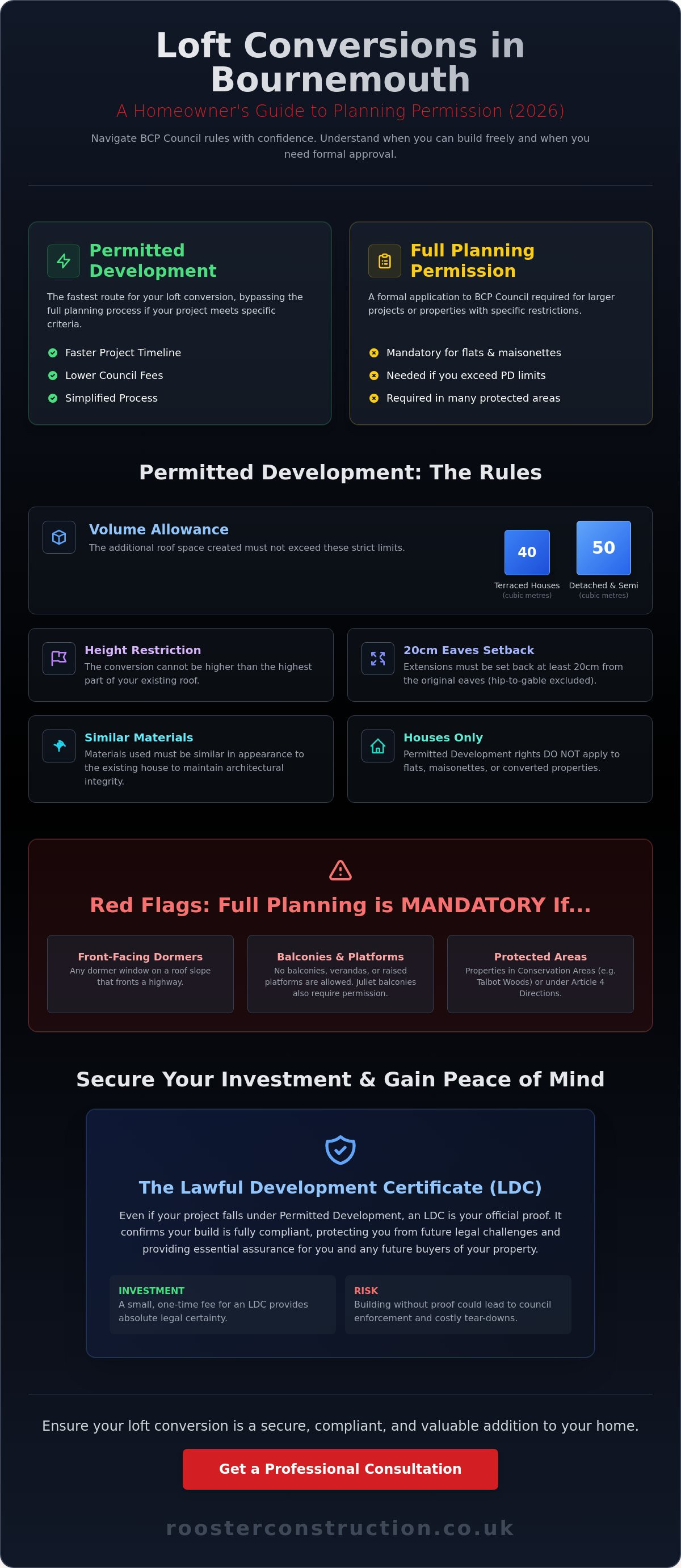
Understanding the specific thresholds for Permitted Development is essential for any homeowner. While many projects avoid the full planning route, specific physical limits define whether your build remains within these rights. For instance, the volume of additional roof space must not exceed 40 cubic metres for terraced houses. For detached and semi-detached properties, this allowance increases to 50 cubic metres. These figures are strict legal boundaries that determine if do i need planning permission for a loft conversion. Staying within these limits allows for a more efficient project timeline, but exceeding them by even a small margin requires a formal application to BCP Council.
Beyond volume, the silhouette of your home must be respected. The conversion cannot exceed the height of the highest part of the existing roof. Additionally, any extension, excluding hip-to-gable designs, must be set back at least 20cm from the original eaves to minimize the visual impact on the streetscape. The official government guidance on loft conversions emphasizes that materials must be of a similar appearance to the existing house. This ensures that even a bespoke modern addition maintains the architectural integrity of Bournemouth's diverse neighborhoods. We take great pride in ensuring every refurbishment feels like a seamless part of the original structure.
Dormers and Balconies: The Red Flags
Front-facing dormers that overlook a highway almost always require a full planning application. This is a common point of confusion for homeowners. Similarly, the "No Balcony" rule is strictly enforced. Even a small Juliet balcony can trigger the need for formal council approval. If your vision includes these features, we can help you navigate the application process with meticulous attention to detail at Rooster Construction. We believe in transparency, ensuring you know exactly what the council requires before the first brick is laid.
Calculating Your Cubic Tonnage
It's a common mistake to assume volume limits only apply to the current project. These allowances are cumulative. If your home has been extended in the past, those previous additions count toward your 40 or 50 cubic metre limit. Understanding which types of loft conversion best fit your remaining allowance is a vital step in the planning phase. This organized approach ensures your investment is protected from future legal challenges, providing the peace of mind that comes with professional validation.
Local Constraints: Bournemouth, Poole, and Dorset Specifics
BCP Council manages a complex urban landscape where high-density residential areas often face stricter oversight than rural counterparts. In certain Bournemouth wards, Article 4 Directions are in place specifically to preserve the character of the neighborhood. These directions strip away the standard Permitted Development rights for loft conversions, meaning you must submit a full application even for minor changes. This is a common hurdle when determining do i need planning permission for a loft conversion. Our team understands these local nuances, ensuring your project meets the specific requirements of the unified 2026 local plan while maintaining the integrity of your home.
Ecological factors also play a significant role in Dorset. For projects near the New Forest or within specific green corridors, BCP Council may require bat surveys before work begins in 2026. This is especially true for older properties where roof spaces might host protected species. In premium areas like Canford Cliffs or Westbourne, the "street scene" harmony is a priority for planning officers. They look for designs that complement the existing aesthetic rather than dominate it. We focus on building excellence by creating bespoke spaces that respect these local environmental and architectural standards, ensuring a seamless transition from old to new.
Living in a Dorset Conservation Area
Conservation status fundamentally changes the planning landscape. In areas like West Cliff, Talbot Woods, or Boscombe Manor, Permitted Development rights are significantly restricted or removed entirely. If you own a listed building in Wimborne or Christchurch, a meticulous approach is mandatory. Every detail, from the profile of the window frames to the exact match of the roof tiles, undergoes scrutiny to preserve historical integrity. We provide the steady hand needed to navigate these sensitive requirements, ensuring your refurbishment meets every conservation standard without the stress of administrative friction.
The BCP Council Planning Portal
Submitting your project through the BCP Council Planning Portal requires precise digital documentation and a clear understanding of local submission requirements. Knowledge of how BCP planning officers assess bespoke designs can prevent your project from being rejected due to minor technicalities. We handle the complexities of these local digital submissions as part of our turnkey service, giving you total peace of mind. If you're ready to discuss your project with local experts who understand the Dorset landscape, contact our team for a professional consultation today.
Securing Your Investment: Lawful Development Certificates
A Lawful Development Certificate (LDC) is the ultimate peace of mind document for any homeowner. It provides official proof from BCP Council that your project fell within Permitted Development rights at the time of construction. While many ask, do i need planning permission for a loft conversion, the follow-up question should be how to document the answer. Without an LDC, you may face significant hurdles when selling your property in Bournemouth or Poole. Buyers and solicitors will demand proof of legality. Relying on indemnity insurance is a risky alternative that often complicates the sale process and fails to provide the same level of professional reassurance.
We manage this entire process as part of our turnkey service. This includes handling all council correspondence and ensuring that every certificate is in place before the build is finalized. Our commitment to integrity means we don't leave these details to chance. We ensure your investment is protected by following the strict BCP Council guidelines, including the updated fee structures that saw a 3.8% increase on April 1, 2026. This meticulous approach guarantees that your bespoke space is not just beautiful, but legally beyond reproach.
Building Regulations vs. Planning Permission
It's crucial to distinguish between these two legal requirements. Planning permission concerns the external impact on the neighborhood. Building Regulations focus on the structural safety, fire protection, and thermal efficiency of the space. Even if your project doesn't require planning permission, it always requires Building Regulations approval. BCP Council's Building Control department must inspect and sign off on the work to ensure it's habitable. You can learn more about this in our loft conversion specialists guide for choosing builders who handle both aspects seamlessly.
Next Steps: Your Bournemouth Loft Project
Every successful conversion begins with a professional feasibility study. This initial assessment identifies structural constraints and confirms whether your design fits within Permitted Development rules. We provide a meticulous review of your property to ensure that your vision aligns with local BCP regulations. This organized approach prevents costly errors and ensures a seamless transition from dream to reality. If you're ready to secure your property’s future, Contact Rooster Construction for a bespoke planning assessment today. We're here to guide you through every stage of your Dorset home's transformation.
Transform Your Home with Professional Certainty
Determining do i need planning permission for a loft conversion requires a balance of national policy and local BCP Council nuances. You've learned that while Permitted Development offers a streamlined path, specific volume limits and local Article 4 Directions can shift the requirements. Securing your investment with a Lawful Development Certificate remains the most reliable way to ensure your property's value is protected for years to come. It's a vital step that removes ambiguity when it's time to sell your home.
With 15+ years of experience in Dorset residential construction, we provide the steady hand needed to manage every detail of your build. Our turnkey management covers everything from initial council correspondence to the final meticulous inspection. We take pride in our building excellence, ensuring your bespoke space meets all BCP Council building regulations with total transparency. It's about more than just construction; it's about delivering peace of mind through every phase of the project.
Take the first step toward your new space with confidence. Book your free loft conversion feasibility study in Bournemouth today and let us handle the complexities while you focus on the vision for your home. Your dream renovation is well within reach when backed by professional integrity.
Frequently Asked Questions
How long does it take to get planning permission for a loft conversion in Bournemouth?
BCP Council typically operates on an 8-week statutory timeline for householder planning applications. This period begins once your application is validated on the national Planning Portal. We recommend using their paid pre-application advice service to resolve potential issues early, which often prevents delays during the formal assessment phase. Our meticulous project management ensures all documentation is correct from the start to maintain this schedule.
Can I convert my loft if I live in a conservation area in Poole?
You can certainly convert your loft in a Poole conservation area, but you'll likely require full planning permission. Most properties in these protected zones have their Permitted Development rights restricted or removed through Article 4 Directions. When considering do i need planning permission for a loft conversion in areas like Canford Cliffs, the focus shifts to preserving the local character. We specialize in bespoke designs that respect these architectural standards.
What happens if I build a loft conversion without planning permission?
Building without required approval risks an enforcement notice from BCP Council, which can force you to dismantle the entire project. This leads to substantial financial loss and significant legal complications. It also makes selling your property nearly impossible, as solicitors will identify the lack of paperwork. We prioritize integrity by ensuring every build is fully compliant and legally protected before construction begins.
Do I need my neighbours permission for a loft conversion in Dorset?
You don't need a neighbour's permission for the planning application itself, but you must comply with the Party Wall Act 1996. This legal requirement involves serving a formal notice to any neighbour sharing a boundary wall at least two months before work starts. If they dissent, a surveyor is appointed to create a Party Wall Award. It's a separate legal process from planning that ensures structural safety for both properties.
Is a Lawful Development Certificate the same as Planning Permission?
No, they serve different purposes. Planning permission is a request for approval for a specific design, while a Lawful Development Certificate (LDC) is official confirmation that your project is legal under Permitted Development rights. An LDC is the most effective way to answer the question, do i need planning permission for a loft conversion, by providing a permanent legal record. It's an essential document for future property transactions in Bournemouth and Poole.


Comments