.png)
Plastering and Rendering: Achieving a Flawless Finish for Your Dorset Home
Your home’s walls are more than just structural boundaries; they are a protective skin that determines whether your property feels like a sanctuary or a source of constant maintenance. When planning a refurbishment, it is common to feel a sense of hesitation regarding plastering and rendering, particularly when considering the unique challenges of our Dorset coastal environment. You likely want a finish that looks exceptional and remains resilient against damp, yet the fear of hairline cracks or the stress of finding a reliable tradesman who values integrity can be daunting.
We believe that the technical side of your build should never be a source of anxiety. This guide will clarify the essential differences between internal and external finishes, showing you how they provide the structural protection and bespoke beauty your renovation deserves. We will examine how to achieve a smooth, paint-ready interior and a weather-protected exterior that enhances curb appeal. You will also gain a clear understanding of the professional quality standards and timelines required to ensure your project is completed with meticulous care and building excellence.
Key Takeaways
Understand the distinct roles of internal and external finishes in providing both aesthetic excellence and essential structural protection for your property.
Discover how to choose the ideal materials for plastering and rendering, balancing traditional craftsmanship with modern, weather-resistant technology.
Learn the critical importance of meticulous surface preparation to ensure your finish withstands the unique challenges of the Dorset coastal climate.
Explore how professional finishing transforms raw building works into seamless, bespoke living spaces during a loft conversion or home extension.
Table of Contents
Understanding Plastering and Rendering: The Internal and External Essentials
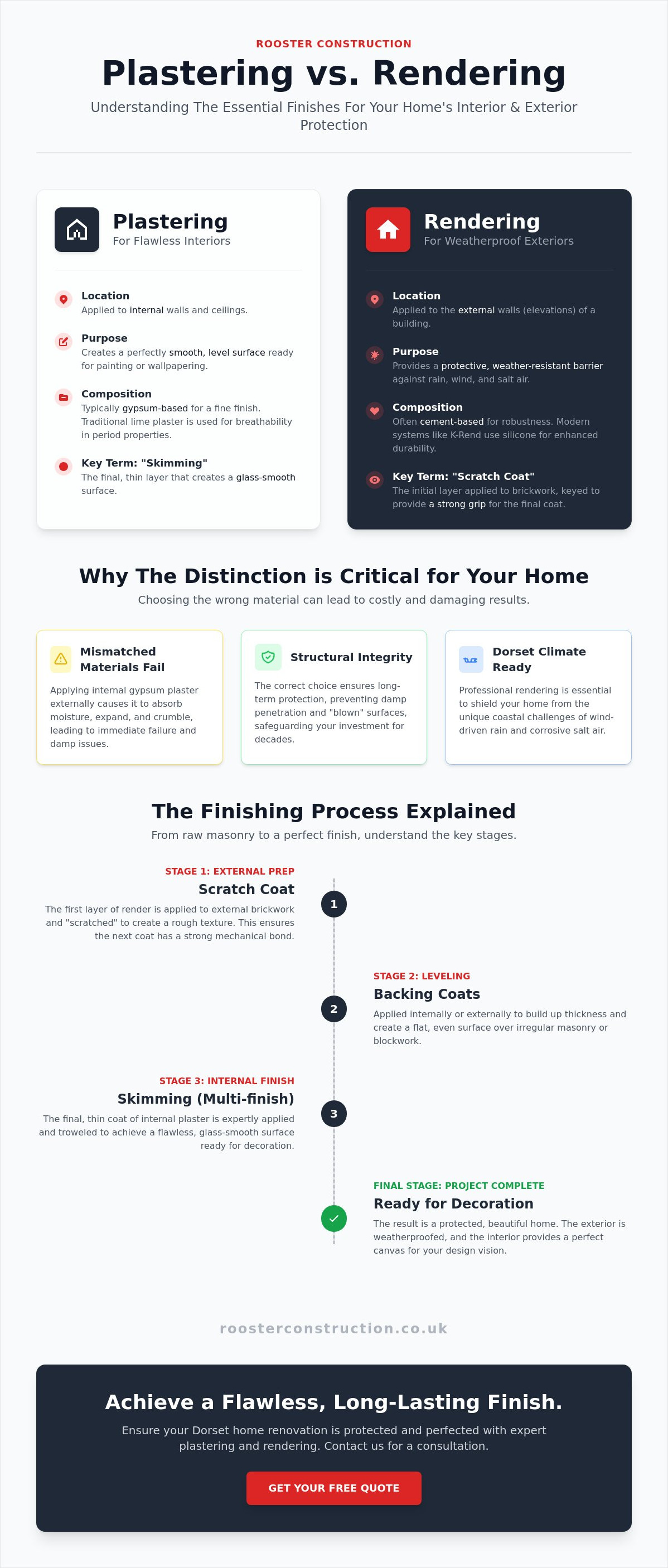
To achieve a high-end finish in a Dorset home, you must first distinguish between the two primary wall treatments. Plastering is the skilled application of material to interior walls and ceilings, designed to create a perfectly level, smooth surface ready for decoration. Conversely, rendering involves applying a thicker, protective coating to external elevations to shield the building from wind-driven rain and salt air. While they share similar application techniques, their chemical compositions are fundamentally different. Plaster is typically gypsum-based and designed for breathability within a controlled indoor climate, whereas render is often cement-based to provide a robust, weather-resistant barrier. Gaining a foundational understanding of plasterwork and its historical development helps homeowners appreciate why these materials cannot be used interchangeably. Both processes are the essential final steps in any turnkey renovation, bridging the gap between raw construction and a polished, bespoke home.
To see these techniques in action, watch this practical demonstration of a modern wall system:
Why the Distinction Matters for Your Property
Choosing the wrong material can lead to catastrophic results for your home’s structure. If you were to apply internal gypsum plaster to an external wall, the material would absorb moisture, expand, and fail almost immediately. Professional application is about more than just aesthetics; it's about structural integrity. By ensuring the correct material is matched to the specific environment, we provide a finish that won't just look excellent on day one but will protect your investment for decades. This meticulous approach to plastering and rendering prevents common issues like damp penetration and blown surfaces.
Common Terminology for Homeowners
Navigating industry terms doesn't have to be confusing. You’ll often hear the term "skimming," which refers to the final thin layer of plaster that creates a glass-smooth finish. Before that, "backing coats" are used to level out uneven masonry. For external work, a "scratch coat" is the initial layer applied to the brickwork, keyed to provide a firm grip for the final decorative render. Whether you're opting for traditional lime or modern silicone-based systems, knowing these terms helps you communicate effectively with your build team and ensures transparency throughout the project.
Choosing the Right Materials for a Bespoke Finish
Selecting the right materials is the cornerstone of building excellence. It's the difference between a finish that merely looks good and one that lasts for generations. For internal projects, gypsum plaster is the modern choice for its rapid drying times and smooth results. However, period properties in Dorset often require the breathability of traditional lime plaster to prevent moisture being trapped within the walls. When we approach plastering and rendering, we prioritize the long-term health of the building alongside its visual appeal. This commitment to integrity means we only use premium systems from brands such as K-Rend or Weber, ensuring that your house extension or refurbishment benefits from the highest industry standards. The choice between different systems for plastering and rendering often depends on whether you're working on a modern extension or a heritage refurbishment.
Internal Plastering: From Skimming to Decorative Finishes
A flawless interior starts with a "multi-finish" approach. This involves a meticulous two-coat process that results in a seamless, paint-ready surface. Achieving this level of precision is a vital component of any successful property renovation, as it provides the perfect canvas for your bespoke interior design. Whether you're smoothing over old masonry or finishing new stud walls, the quality of the skim determines the final aesthetic of the room. We ensure every corner is sharp and every surface is level, reflecting our disciplined approach to craftsmanship.
External Rendering: Protection Meets Curb Appeal
For homes along the Dorset coastline, the external finish must work incredibly hard. Silicone-based renders are particularly effective here; they offer superb water repellency while remaining breathable, allowing moisture to escape from the building. If you're looking for a low-maintenance option, monocouche rendering is an excellent "one-coat" solution. Because it is through-coloured, it eliminates the need for frequent repainting and stays looking fresh for years. While traditional sand and cement render remains a common choice, modern silicone systems, which average approximately £80 to £110 per m² in 2026, offer the flexibility needed to prevent cracking in changing temperatures. If you are planning a project, our team can help you select a bespoke finish that suits your home's unique character.
The Role of Finishing in Loft Conversions and Extensions
The transition from a construction site to a refined living space is most evident during the finishing phase. In a loft conversion, plastering is the alchemy that turns timber frames and insulation into a warm, inviting bedroom or office. This stage must follow the meticulous completion of general building works, including all first-fix electrical and plumbing installations. We never rush this sequence. Ensuring that cables and pipes are securely positioned before the walls are sealed is vital for the long-term integrity of the build. Once the plastering and rendering are complete, the room finally gains its shape and light-reflecting qualities.
Patience is required during the curing process. While a thin skim coat might look ready for paint within 3 to 5 days, thicker backing coats or external renders take longer to dry fully. We advise homeowners to allow for natural ventilation rather than using intense heat, which can cause surface cracking. A perfectly level plaster finish is also the essential foundation for high-end carpentry and joinery. Without flat walls, skirting boards and bespoke wardrobes will never sit flush, undermining the quality of the entire refurbishment. If you are planning a structural change, our team can manage the entire process from the first brick to the final skim.
Seamless Integration in House Extensions
When adding a house extension, the goal is often to make the new structure look as though it has always been there. Professional rendering is the key to this visual harmony. We use movement beads at the junction where the new masonry meets the old. These discreet strips allow for the natural expansion and contraction of different building materials, preventing the unsightly cracks that often plague lower-quality builds. This attention to detail ensures your extension remains weather-tight and aesthetically seamless.
Creating the Foundation for Kitchen and Bathroom Renovations
In high-moisture environments, the choice of substrate is critical. We utilize specialist moisture-resistant plasterboard in kitchen and bathroom renovations to prevent damp issues behind the scenes. Furthermore, achieving perfectly "plumb" and square walls is non-negotiable for these projects. Bespoke cabinetry and intricate tiling patterns demand a level of precision that only expert plasterers can provide. This disciplined approach ensures that your premium fixtures fit perfectly, with no awkward gaps or uneven grout lines.
Achieving Professional Standards in the Dorset Climate
The coastal geography of Bournemouth, Poole, and Christchurch presents a unique set of variables for external finishes. High winds and salt-laden air act as abrasive forces against a building's envelope, making the choice of material and application method critical. Inland standards simply won't suffice here. We understand that integrity in surface preparation is the only defense against blown render or salt-induced damp. This meticulous approach ensures that the bond between the substrate and the finish remains absolute, even in the harshest winter gales. By choosing a turnkey service, you ensure that the team managing your structural build is the same team responsible for the final skim, eliminating the communication gaps that often lead to compromised quality.
To verify the excellence of a plastering and rendering job, homeowners should look for several key markers of professional standards:
Surface Uniformity: There should be no visible trowel marks, ridges, or "mapping" where the outline of the bricks shows through the render.
Sharp Detailing: Corner beads and joints around windows and doors must be perfectly straight and clean.
Texture Consistency: For rendered finishes, the grain or "flick" should be even across the entire elevation.
Internal Smoothness: Plastered walls should feel glass-smooth to the touch, with no pitting or "fat" left in the corners.
Why Professional Application Trumps DIY
The risks of a poorly executed finish go beyond aesthetics. "Ghosting" or "mapping" occurs when the render is applied too thinly or without proper suction control, revealing the masonry pattern underneath when it rains. Professional plasterers use their expertise to achieve the flat, mirror-like finish required for modern, high-intensity lighting. Any imperfection in the plaster is magnified by LED downlights or wall washers; only a disciplined hand can produce a surface capable of withstanding that level of scrutiny.
The Rooster Construction Promise: Excellence and Integrity
Every home renovation we undertake is treated as a unique project requiring a bespoke approach. We don't believe in mass-produced solutions or cutting corners during the preparation phase. Our reputation is built on the stability and beauty of our physical builds, from the first foundation stone to the final coat of paint. If you value transparency and a stress-free experience, contact Rooster Construction for a bespoke consultation to discuss your project requirements.
Investing in the Longevity of Your Dorset Home
Achieving a flawless finish is the ultimate expression of building excellence. We have explored how the right choice of materials, from breathable lime to modern silicone renders, protects your property against the unique coastal pressures of Dorset. Whether you are finishing a loft conversion or extending your living space, the quality of your plastering and rendering remains the defining factor in your home's aesthetic and structural health. It's the steady hand of an expert that ensures these finishes endure for decades rather than just seasons.
With over 15 years of local building excellence, Rooster Construction provides the comprehensive turnkey project management required for such meticulous work. We specialize in bespoke residential conversions where integrity and craftsmanship are never compromised. Our team is ready to guide you through every stage of your refurbishment with transparency and care. Request a meticulous quote for your Dorset renovation today. We look forward to helping you create a space that reflects your high standards and stands the test of time with quiet confidence.
Frequently Asked Questions
How long does it take for internal plaster to dry before I can paint?
A standard skim coat typically requires 3 to 5 days to dry sufficiently before you can begin decoration. If your renovation involved deeper backing coats to level uneven masonry, this curing period can extend to 4 weeks. You'll observe the plaster turning from a dark brown to a uniform light pink as it dries. It's vital to let this process happen naturally; using intense portable heaters can cause the surface to dry too quickly and crack.
What is the best type of render for a house near the Bournemouth coast?
Silicone-based render is the superior choice for properties in Bournemouth, Poole, and Christchurch due to its flexibility and breathability. This material is specifically engineered to repel wind-driven rain while allowing moisture to escape from the building's structure. Its ability to withstand the abrasive effects of salt air makes it a more durable option than traditional sand and cement for coastal environments. This modern system also helps prevent the cracks often caused by thermal expansion in exposed locations.
Can you render over old brickwork or existing pebble dash?
You can render over existing brickwork or pebble dash, provided the underlying substrate is structurally sound. The success of the project depends on meticulous preparation, which may include removing loose stones or applying a high-bond primer. We often utilize a mesh-reinforced base coat to bridge the old surface and the new finish. This disciplined approach to plastering and rendering ensures the final result is stable, level, and built to last.
Is it normal for new plaster to have small hairline cracks?
Minor hairline cracks can occasionally appear as the plaster loses moisture or the building undergoes slight thermal movement. These are usually superficial and can be easily managed during the mist-coat painting stage. However, significant or wide cracks are not standard and may suggest the material dried too rapidly or the substrate was poorly prepared. Our focus on integrity means we take every precaution during the application phase to ensure a robust, high-quality finish.
How much does plastering and rendering cost for a standard extension in 2026?
In 2026, the investment for plastering and rendering is determined by the specific materials and the scale of your extension. High-performance silicone or acrylic renders typically range between £80 and £110 per m², including both materials and labor. For internal finishes, professional skimming averages approximately £24 per m². We provide bespoke, transparent quotes that reflect the meticulous standards required for a premium Dorset home, ensuring there are no hidden surprises during your build.


Comments