.png)
Permitted Development Rights for Extensions in Dorset: The 2026 Homeowner's Guide
What if the most significant barrier to your home transformation isn't the local council, but a simple misunderstanding of the rules? Many homeowners across our county feel a justified sense of hesitation when considering a new project, fearing that a single misstep in interpretation could lead to legal repercussions or stalled construction. Whether you're situated near the Jurassic Coast or on the edge of the New Forest, the specific constraints of our region often make the process feel more daunting than it needs to be. We understand that you value both the integrity of your property and the peace of mind that comes from professional certainty.
Our guide clarifies how you can utilize permitted development rights for extensions Dorset to extend your living space without the need for a full planning application. You'll gain a clear understanding of the 2026 size limits, such as the 4 metre depth for detached homes, and learn why the £130 informal enquiry fee is a wise investment for your project's security. We'll provide a straightforward yes or no framework for your extension, distinguish between planning and building regulations, and outline the exact steps required to move from a vision to a completed, high-quality build.
Table of Contents
What Are Permitted Development Rights for Dorset Extensions?
Permitted development rights (PDR) represent a government-backed framework designed to allow homeowners to improve their properties without the friction of a full planning application. This system is governed by the General Permitted Development Order, which grants a general planning permission for several types of building work. For those considering permitted development rights for extensions Dorset, this means specific projects are deemed pre-approved as long as they meet strict national criteria. It's an efficient way to expand your home while maintaining the technical integrity of the local landscape.
A critical factor in determining your eligibility is the "original house" rule. This refers to the property as it stood on 1 July 1948, or as it was first built if constructed after this date. If previous owners have already extended the property, those additions count towards your total allowance. This historical context is vital for planning house extensions Dorset residents often undertake. It ensures that the scale of new work remains proportionate to the original plot, preventing over-development in our established neighbourhoods.
The Benefits of Using PDR for Your Home Improvement
Utilising PDR offers a more streamlined path than the traditional 8 to 12 week planning cycle. It provides a level of certainty that is often missing in the discretionary planning process. By following a clear set of rules, you can move toward the construction phase with confidence.
Substantial Time Savings: You bypass the lengthy public consultation periods and committee reviews required for full applications.
Reduced Administrative Costs: While Dorset Council updated its informal enquiry fee to £130 on 1 April 2026, this remains a more cost-effective route than full submissions for residents in Bournemouth and Poole.
Pre-construction Certainty: Working with a meticulous builder allows you to design within known limits. This reduces the risk of a project being rejected late in the process, providing essential peace of mind.
The Technical Limits for Single-Storey Extensions
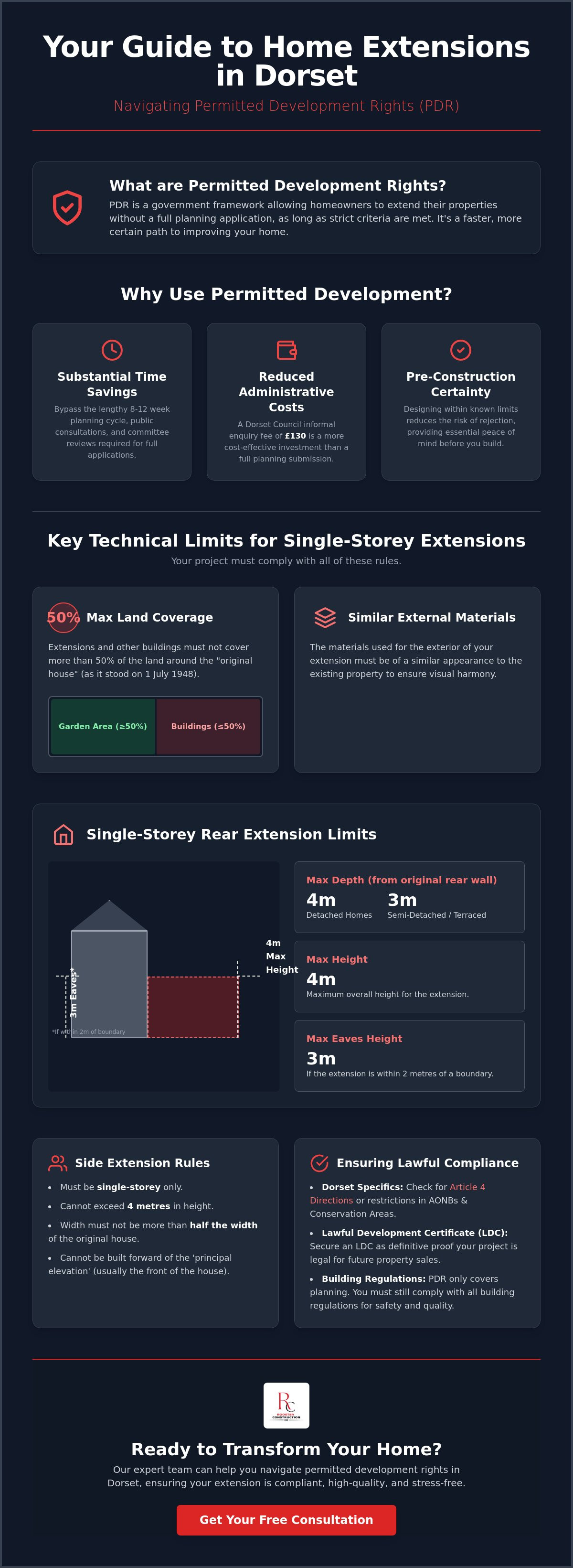
Success in a building project depends on precision. When exploring permitted development rights for extensions Dorset, the first constraint to respect is the 50% rule. This stipulates that you cannot cover more than half the land area around the original house with extensions or other outbuildings. It's a vital measure that preserves the balance between built structures and open garden space, ensuring our local neighbourhoods remain airy and well-proportioned.
Height and depth limits are equally uncompromising. For a single-storey rear extension to qualify under standard PDR, the maximum height is capped at 4 metres. If the structure sits within 2 metres of a boundary, the eaves height is further restricted to 3 metres. According to the official government technical guidance, detached homes are permitted a 4-metre rear depth, while semi-detached or terraced properties are limited to 3 metres. These measurements are taken from the rear wall of the original house, not from any later additions. If you're unsure how these limits apply to your specific plot, discussing your vision with an expert builder in Dorset can help define the exact parameters of your project.
Visual harmony is also a legal requirement. The materials used for the exterior of your extension must be of a similar appearance to those on the existing property. This ensures that the new addition feels like a natural evolution of the home rather than a jarring afterthought. This attention to detail is what separates a standard build from a high-quality home improvement.
Side Extensions and Boundary Considerations
Side extensions carry their own set of meticulous rules. They must be single-storey and cannot exceed 4 metres in height. Crucially, the width of a side extension must not exceed half the width of the original house. You must also maintain specific distances from boundaries to avoid infringing on neighbouring Dorset properties, ensuring your project remains respectful of local privacy. A 'principal elevation' refers to the wall of the house that faces the highway, usually the front; you cannot build beyond this wall under permitted development.
Navigating Dorset-Specific Restrictions: AONBs and Conservation Areas
While national standards provide a baseline, the permitted development rights for extensions Dorset homeowners enjoy are often subject to local overlays. Dorset Council frequently employs Article 4 Directions. These legal instruments allow the council to withdraw specific PDRs in certain areas to protect the unique character of a neighbourhood. If your home is situated in a historic part of Christchurch or Wimborne, you might find that the freedom to extend without a full planning application has been restricted or removed entirely.
The constraints become even more rigorous within "Designated Areas." This classification includes National Landscapes, formerly known as Areas of Outstanding Natural Beauty (AONB), such as the New Forest or the Jurassic Coast. In these protected zones, the larger home extension allowances of 6 and 8 metres are unavailable. The standard limits of 3 or 4 metres apply instead. For those residing in listed buildings, PDRs are almost entirely non-existent. Any modification to a heritage home requires a meticulous approach and formal consent to ensure the historical integrity remains intact. This disciplined respect for our county's architecture is a core pillar of a successful project.
Local Planning Nuances in Bournemouth and Poole
The BCP Council area introduces its own set of professional considerations. For properties within the Poole Harbour catchment area, "Nitrate Neutrality" rules can occasionally impact larger extensions that might significantly change how a home is used. It is essential to verify whether your property falls under a designated area or is subject to specific environmental constraints before you commit to a design. If you need a reliable partner to help you determine the feasibility of your project, we offer expert house extensions in Dorset that prioritise both technical compliance and high-end results.
A steady hand and a clear plan are required to navigate these regional nuances. By identifying these constraints early, you avoid the stress of unexpected legal challenges and ensure your investment is protected. This proactive approach allows for a smooth transition from the initial vision to the practicalities of construction.
From PDR to Reality: Ensuring Your Dorset Extension is Lawful
Securing the legal standing of your project is just as critical as the physical construction. While you may have confirmed your eligibility for permitted development rights for extensions Dorset, obtaining a Lawful Development Certificate (LDC) remains a vital step. This document serves as official confirmation from the council that your project is lawful and did not require planning permission. It acts as your definitive proof of compliance. Without it, you may face significant hurdles when you eventually decide to sell your home, as any meticulous Dorset solicitor will demand proof of legality during the conveyancing process. A disciplined builder ensures that the final structure adheres strictly to the PDR-compliant designs, protecting both your investment and your peace of mind. If a rear extension isn't the right fit for your plot, a loft conversion offers another excellent way to utilize these rights to enhance your living space.
Planning Permission vs. Building Regulations
It's a common misconception that bypassing planning permission removes all regulatory oversight. While planning focuses on the aesthetic and communal impact of a build, Building Regulations are concerned with the technical integrity and safety of the structure. These include essential checks on fire safety, structural stability, and thermal efficiency under Part L of the regulations. Building Regulations are mandatory for every extension regardless of whether it falls under permitted development rights for extensions Dorset. Compliance ensures your new space is not only beautiful but safe and sustainable for years to come.
Next Steps with Rooster Construction
At Rooster Construction, we guide Bournemouth homeowners through every phase of the PDR verification process with a steady and experienced hand. Our approach is rooted in honesty and clarity, ensuring that every detail of your residential extension meets the highest standards of craftsmanship and legal integrity. We take pride in delivering a comprehensive, end-to-end service that transforms your vision into a finished reality without the usual stress of home improvement. Contact Rooster Construction today for a professional assessment of your Dorset extension project.
Realising Your Property's Potential with Confidence
Navigating the path to a larger home doesn't have to be a source of stress. By mastering the technical limits of the 50% rule and understanding the specific geographic constraints of our county, you can move forward with a clear plan. Securing a Lawful Development Certificate remains the final, essential step to protect your property's value and ensure a smooth sale in the future. Utilizing permitted development rights for extensions Dorset is a sophisticated way to enhance your living space while respecting the unique character of our region.
As a Bournemouth-based family-managed team with over 15 years of Dorset construction expertise, we pride ourselves on being the steady hand that guides you through every complexity. We're specialists in residential extensions and loft conversions, committed to delivering high-end results through professional ethics and meticulous project management. Our focus is always on providing the peace of mind you deserve during your home transformation. Start your hassle-free Dorset extension with Rooster Construction and take the first step toward a beautiful, compliant addition to your home. We look forward to helping you build something exceptional.
Frequently Asked Questions
Do I need a Lawful Development Certificate for an extension in Dorset?
While not a legal requirement to begin construction, obtaining a Lawful Development Certificate is a vital step for any homeowner. This document provides definitive proof that your project adheres to permitted development rights for extensions Dorset, protecting you during future property sales. It removes ambiguity for solicitors and buyers, ensuring that your investment is recognized as fully compliant and legally sound from the moment work concludes.
Can I build a two-storey extension under Permitted Development in 2026?
You can build a two-storey extension under PDR, provided it meets specific criteria. The addition must be at the rear of the property and cannot exceed 3 metres in depth. It must also be at least 7 metres from the rear boundary. These projects require meticulous planning to ensure the roof pitch matches the existing house, maintaining a harmonious appearance that respects the original architecture of your home.
What happens if I build an extension in Dorset without planning permission or PDR compliance?
Building without a clear legal framework is a significant risk. It exposes you to enforcement action from Dorset Council. If the structure is found to be non-compliant, the council can issue an enforcement notice requiring you to alter or demolish the work at your own expense. This stressful process leads to financial loss and complicates any future sale, as you won't possess the necessary documentation to prove legality.
How close to my neighbour's boundary can I build an extension under PDR?
You can technically build up to the boundary line, but doing so triggers specific height restrictions. If any part of the extension is within 2 metres of the boundary, the maximum eaves height is limited to 3 metres. It's essential to consider the Party Wall Act and maintain respectful communication with neighbours. A disciplined approach ensures your project remains within permitted development rights for extensions Dorset while avoiding boundary disputes.
Does Permitted Development apply to flats or maisonettes in Bournemouth?
Permitted development rights don't apply to flats or maisonettes. These properties require a full planning application for any external changes or extensions. This distinction is a common point of confusion in Bournemouth and the wider Dorset area. It's vital to confirm your property type early. We recommend seeking professional advice to ensure you follow the correct legislative path for your specific dwelling.


Comments