.png)
Party Wall Agreement for Extension in Dorset: A Homeowner’s 2026 Guide
What if the biggest threat to your Dorset home extension isn't a rising material cost or a rainy week, but a simple 14-day silence from your next-door neighbour? It is a common source of anxiety for many homeowners in our tight-knit communities. You are likely eager to break ground, yet the complexity of securing a party wall agreement for extension Dorset projects often feels like a legal minefield that could stall your progress. We understand that you value both the technical integrity of your build and the professional relationship you share with those living nearby.
Approaching these legalities with transparency is the best way to ensure your vision becomes a reality without unnecessary delays. This 2026 guide provides the steady hand you need to manage the requirements of the Party Wall etc. Act 1996 with quiet confidence. We'll examine the specific notice periods required for excavations, the impact of the new Renters' Rights Act on your timeline, and how to manage surveyor costs effectively. You'll gain a clear roadmap to keep your extension on track while maintaining the peace of mind that comes from a project handled with meticulous care.
Table of Contents
Understanding the Party Wall Act for Your Dorset Extension
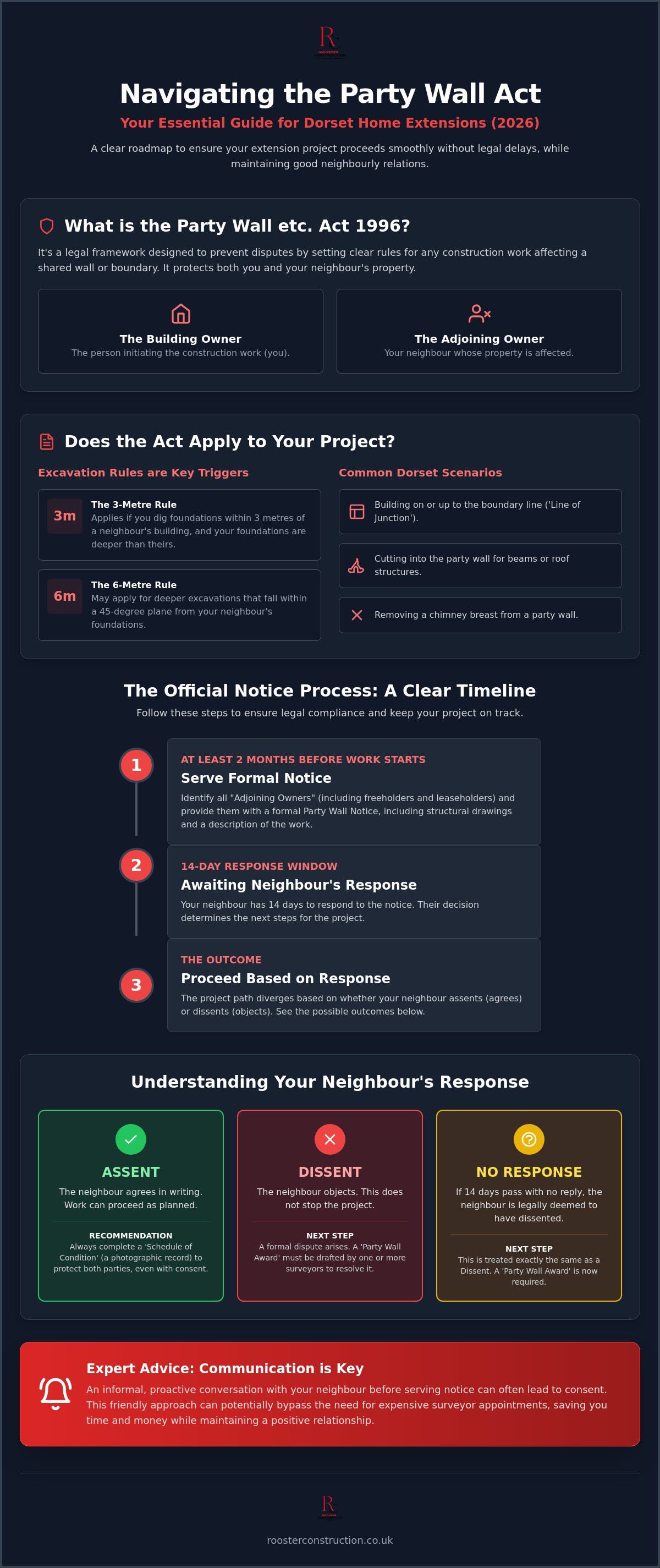
The Party Wall etc. Act 1996 provides the legal framework for residential work that affects shared structures or boundaries. It is a precise mechanism designed to prevent disputes by establishing a clear protocol for communication and structural assessment. In the context of a house extension, you are designated as the "Building Owner," the individual initiating the physical changes. Your neighbour is the "Adjoining Owner," whose property interests and structural safety the Act is intended to protect. Securing a party wall agreement for extension Dorset homeowners often find, is the most reliable way to maintain positive neighbourly relations while protecting their investment. The Party Wall Act serves as a protective measure for both properties, ensuring that construction proceeds with technical rigour rather than functioning as a mere legal hurdle.
The 3-Metre and 6-Metre Rules
Most extensions trigger the Act through excavation. If you dig foundations within three metres of a neighbour's building and those foundations are deeper than theirs, the Act applies. For larger projects involving reinforced concrete or significant depths, the six-metre rule may apply if the excavation falls within a 45-degree plane from the neighbour’s foundations. These rules exist to prevent subsidence or structural movement during the groundworks phase. It's a technical safeguard that requires professional oversight to ensure the safety of both dwellings.
Common Dorset Scenarios Requiring an Agreement
Dorset's varied architecture creates unique requirements for local homeowners. In our experience, several situations frequently necessitate formal notice:
Rear extensions on Victorian terraces: Properties in Bournemouth or Christchurch often involve cutting into the party wall to support new roof structures or floor joists.
Line of junction walls: Building a new wall exactly on the boundary between properties in Poole requires formal notice, even if the wall is entirely on your land.
Structural alterations: Internal works, such as inserting steel beams for a house extension, often rely on the shared wall for support and require compliance with the Act.
The Step-by-Step Process of Serving Notice in Dorset
Identifying your neighbours is the first critical step in the legal timeline. In many Dorset coastal towns, properties are often divided into flats, meaning you may need to serve notice to both the leaseholders and the freeholder. These individuals are collectively known as "Adjoining Owners." Once identified, you must serve a formal Party Wall Notice at least two months before your planned start date. This document is not a mere formality; it is a legal requirement that protects your right to build while respecting the boundaries of those nearby. A well-managed project begins with clear communication, and our team at Rooster Construction can help you align your build schedule with these legal windows.
After the notice is served, your neighbour has 14 days to respond. There are three potential outcomes:
Assent: The neighbour agrees in writing, and work can proceed.
Dissent: The neighbour objects, usually due to concerns about noise or structural safety.
No Response: If 14 days pass without a reply, the neighbour is legally deemed to have dissented, and a dispute is considered to have arisen.
Regardless of the response, we strongly recommend a "Schedule of Condition." This is a meticulous photographic and written record of the neighbour’s property before work begins, providing clear evidence should any damage be claimed later.
The Party Wall Notice Period
Serving your notice early ensures your home renovation project stays on schedule. A valid notice must include a clear description of the work, structural drawings, and the proposed start date. Errors in these documents can render the notice void, potentially forcing you to restart the two-month waiting period from scratch.
What Happens if a Neighbour Dissents?
A dissent is not a project cancellation. It simply moves the process into a formal phase where a "Party Wall Award" is drafted. You can appoint an "Agreed Surveyor" to act for both parties, which is often the most cost-effective route for a party wall agreement for extension Dorset homeowners. Professional standards for these experts are maintained by the Royal Institution of Chartered Surveyors (RICS), ensuring a fair and technical resolution for all involved.
Managing Neighbour Relations and Avoiding Project Delays
A proactive approach often dictates the speed and success of your project. While the legal framework is essential, we advocate for the "Quiet Confidence" method: an informal conversation over tea before any formal paperwork arrives. In close-knit Dorset communities, a surprise legal letter can create unnecessary friction. By presenting your house extensions Dorset plans early, you demonstrate a commitment to transparency that often secures immediate consent. Statistics show that around 45% of all party wall notices are consented to by the neighbour, which bypasses the need for costly surveyor appointments and keeps your timeline intact.
Addressing common anxieties regarding noise, dust, and working hours is vital for maintaining local goodwill. Residents in residential areas from Christchurch to Wimborne naturally worry about the daily impact of construction on their quality of life. Providing a clear schedule of works and explaining the protective measures in place establishes you as a responsible homeowner. A Party Wall Agreement is a professional tool designed for mutual peace of mind, not a signal of impending conflict.
Common Pitfalls in Bournemouth & Poole Extensions
Dorset’s high density of converted flats and rental properties can complicate the notification process. Under the Renters' Rights Act 2026, enhanced consultation with tenants is now a legal necessity for works involving rental properties. Failing to identify all legal owners, including distant freeholders or the landlords of tenanted adjoining properties, is a frequent cause of delay. To confirm ownership details before serving notice, you can explore Residential Sales through Triangle Legal Services Limited to ensure your Land Registry records are accurate. You should also account for the dissent process; if a neighbour does not consent, the transition to a formal Award typically adds 4 to 6 weeks to your pre-construction phase.
The Cost of Non-Compliance
Proceeding without a valid party wall agreement for extension Dorset requirements is a high-risk strategy. Neighbours can seek a court injunction to halt construction immediately, leading to significant financial losses and legal fees. Without a professional Schedule of Condition, you are also vulnerable to unverified damage claims that are difficult to refute after the fact. To ensure your project begins on a solid legal and social foundation, contact our expert team today for professional guidance on your extension.
How Rooster Construction Integrates Party Wall Compliance
While the legal documentation is drafted by surveyors, the practical execution of those terms rests entirely with your building team. At Rooster Construction, we view a party wall agreement for extension Dorset projects as a vital blueprint for site conduct. We coordinate directly with your appointed surveyor to ensure our construction methodology aligns perfectly with the terms of the Party Wall Award. This collaboration ensures that every stage of the build, from the initial break-ground to the final roof tile, remains within the legal boundaries established at the start of the process.
Adhering to the Award involves more than just structural safety; it dictates how we manage daily operations. We strictly observe the working hours and site access rights specified in the document to protect your neighbour's quiet enjoyment. Precision is paramount when excavating foundations, as our work must mirror the structural drawings served in the original notice. Any deviation can lead to legal complications, so we maintain rigorous standards of accuracy. Upon completion, we conduct final walkthroughs to verify that the adjoining property remains in its original state, providing a transparent conclusion to the construction phase.
The Value of Professional Project Management
Our 15 years of experience in Dorset residential construction allows us to streamline the transition from legal paperwork to the physical build. We understand that high-quality carpentry and joinery require a stable structural foundation, and we ensure all structural works respect the agreed boundaries. By managing the technical details of the Award, we provide the steady hand necessary to navigate the complexities of a modern home extension with quiet confidence.
Starting Your Dorset Extension Project
Successful projects rely on integrating architectural vision with practical legal considerations from day one. Early planning allows us to identify potential party wall issues before they become costly delays. If you're ready to begin your journey, contact Rooster Construction for a professional extension consultation in Dorset to discuss how we can bring your vision to life with precision and care.
Securing Your Dorset Home’s Future with Professional Oversight
Success in a home extension project is often defined by the meticulous steps taken before the first brick is laid. By prioritising transparent communication with your neighbours and adhering to the legal framework of the Party Wall Act, you transform a potential hurdle into a project-management safeguard. This proactive approach ensures your structural ambitions are grounded in professional ethics and technical precision. Navigating a party wall agreement for extension Dorset projects doesn't have to be a source of stress when you have an established partner to guide you through every stage of the process.
At Rooster Construction, we bring over 15 years of Dorset building expertise to every project. Our team provides comprehensive project management, handling everything from the initial notice coordination to the final completion walkthrough. We are specialists in Bournemouth and Poole residential improvements, dedicated to maintaining the high standards and traditional craftsmanship your home deserves. Book a Professional Extension Consultation with Rooster Construction today. Your dream home is within reach; let's build it on a foundation of clarity and neighbourly trust.
Frequently Asked Questions
Do I really need a party wall agreement for a small extension in Dorset?
The requirement for an agreement depends on the proximity and depth of your foundations rather than the overall size of your extension. If you're excavating within three or six metres of a neighbour's structure, or building a new wall on the boundary line, the Party Wall etc. Act 1996 applies. Even a modest rear extension in a residential area like Bournemouth can trigger these legal obligations if the groundworks are deeper than the foundations of the adjoining property.
How much does a party wall agreement typically cost in 2026?
Costs in 2026 vary based on whether your neighbour consents to the works or requires a formal Award drafted by surveyors. For straightforward domestic projects where an "Agreed Surveyor" is used, the typical cost is between £900 and £1,500. If each owner appoints their own surveyor, the combined fees for a simple project usually range from £1,800 to £2,700. As the building owner initiating the extension, you're responsible for paying the reasonable fees associated with the process.
Can I serve a party wall notice myself without a surveyor?
You're legally permitted to serve a party wall notice yourself, provided the document contains all the mandatory information, including structural drawings and a clear description of the works. However, technical errors in the notice can render it invalid, potentially forcing you to restart the statutory notice period. Many homeowners find that professional guidance at this stage ensures a party wall agreement for extension Dorset projects stays on schedule without legal hitches.
What happens if my neighbour ignores the party wall notice?
If a neighbour does not respond within 14 days, they're legally deemed to have "dissented," and a dispute is considered to have arisen. Silence is not consent; it's a trigger for the next phase of the legal process. You'll then need to appoint a surveyor to act on their behalf or seek an "Agreed Surveyor" to draft a formal Award. This ensures the project can proceed legally while protecting the structural interests of both properties.
Does a party wall agreement give me the right to access my neighbour's garden?
The Act provides a statutory right of access to an adjoining owner's land if the work cannot otherwise be reasonably carried out. This commonly includes necessary tasks like erecting scaffolding or performing structural repairs. You must provide your neighbour with adequate notice before entering their property. Our team manages these access requirements with meticulous care, ensuring we respect their privacy while adhering to the specific working hours outlined in the Award.


Comments