.png)
Bespoke Loft Conversions in Bournemouth: The Definitive 2026 Homeowner’s Guide
Updated: Apr 14
What if the most valuable square footage in your Bournemouth home is currently hidden behind a dusty ceiling hatch? While many homeowners see an attic as mere storage, it represents an untapped opportunity to create a bespoke sanctuary that feels like a natural extension of your architecture. We understand that the prospect of a loft conversion often brings hesitation. You might worry about the structural integrity of your roof or feel overwhelmed by the complexities of BCP Council planning permissions and permitted development rights.
It's a significant undertaking, and your desire for a seamless, high-quality finish without the disruption of unreliable tradespeople is entirely justified. This definitive 2026 guide provides the professional reassurance you need to move forward with quiet confidence. You'll discover how a meticulous approach to design can increase your property value by up to 20 percent based on established UK housing market data. We'll explore the specific styles suited to Dorset homes, navigate local regulations, and detail our proven process for delivering a turnkey transformation that prioritises building excellence and integrity.
Key Takeaways
Learn how to assess your property's structural suitability by understanding the critical 2.2-metre head height requirement used by professional Dorset surveyors.
Explore the most effective loft conversion styles for Bournemouth homes, from cost-efficient Velux designs to spacious Dormer extensions that maximise liveable area.
Navigate the updated 2026 BCP Council planning landscape and identify which projects can proceed under Permitted Development rights to streamline your timeline.
Discover how bespoke carpentry and integrated eaves storage can transform a basic build into a seamless, high-value extension of your home’s character.
Understand the advantages of a turnkey design-and-build partner in providing the meticulous project management required for Dorset’s unique building conditions.
Table of Contents Is Your Bournemouth Home Suitable for a Loft Conversion? Types of Loft Conversion: Choosing the Right Style for Your Space Navigating Planning Permission and Building Regs in 2026 Bespoke Design: Creating a Seamless Extension of Your Home Choosing the Right Partner for Your Dorset Conversion
Is Your Bournemouth Home Suitable for a Loft Conversion?
A loft conversion is the process of transforming an underutilised roof void into a bespoke, habitable room that meets modern building standards. For many Dorset homeowners, this represents a sophisticated alternative to moving house. It's an investment that pays dividends; data from Nationwide Building Society suggests that adding a double bedroom and ensuite through a conversion can increase a property's market value by up to 20%.
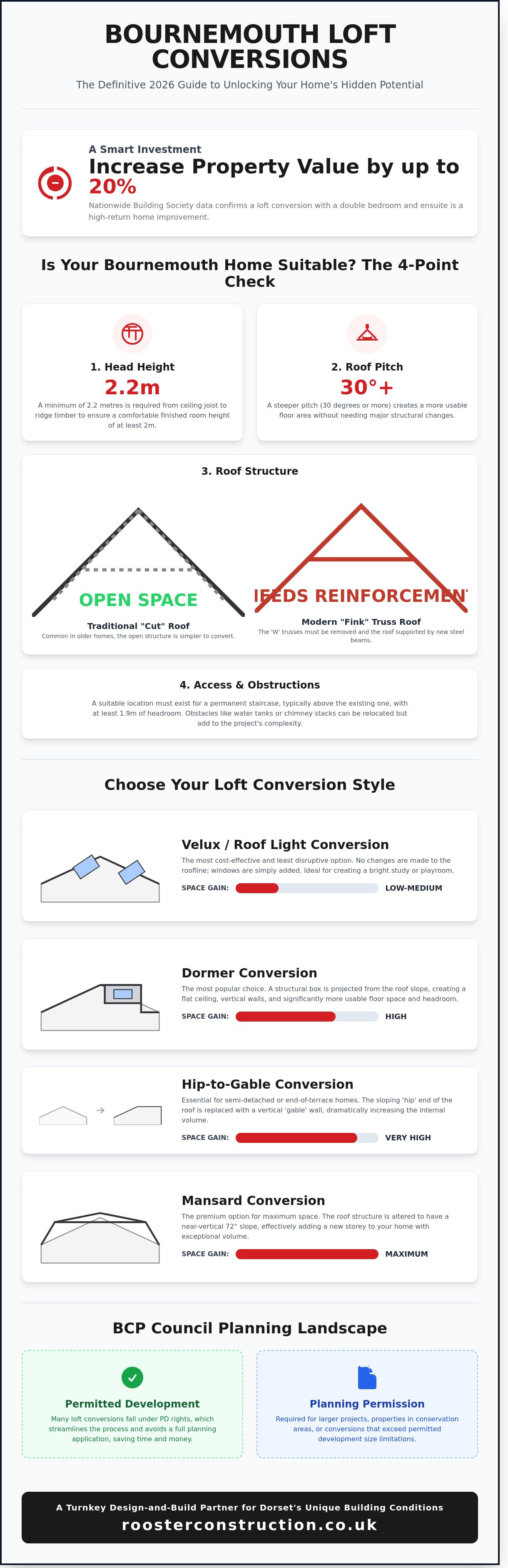
The first metric our surveyors check is the internal head height. You need a minimum of 2.2 metres from the top of the ceiling joists to the bottom of the ridge timber. This ensures that once we install the floor structure and insulation, the finished room maintains a comfortable height of at least 2 metres. If your home falls below this threshold, we can often find solutions by lowering the ceilings on the first floor, though this requires a more meticulous structural approach.
Roof construction also dictates the complexity of the build. Traditional "cut" roofs, common in older Bournemouth properties, use rafters and purlins that leave the central space relatively open. Conversely, many modern homes in Ferndown use fink trusses. These "W" shaped timber frames are under high tension and occupy the entire void. We can still convert these spaces by installing steel beams to support the roof load, allowing us to remove the internal timber webbing safely.
Suitability by Local Property Type
Victorian and Edwardian terraces in Winton often provide excellent volume, though they frequently require party wall agreements and structural upgrades to ageing masonry. The 1930s semi-detached homes around Castlepoint are ideal candidates for hip-to-gable builds. This technique replaces a sloping roof side with a vertical wall, creating significant additional floor space. In Wimborne, modern detached homes with trussed roofs require precise engineering, yet they offer the perfect canvas for a secluded home office or master suite.
The Essential Suitability Checklist
The Pitch: A roof angle of 30 degrees or steeper provides the most usable floor area without requiring significant structural alterations.
Structural Obstructions: Identify if you have large water tanks or chimney breasts in the loft. These can be relocated, but it adds a layer of complexity to the initial phase.
Staircase Placement: You must have a clear path for a permanent staircase. It needs to provide 1.9 metres of headroom and should ideally sit above the existing stairs to maintain the home's natural flow.
Types of Loft Conversion: Choosing the Right Style for Your Space
Every home in Dorset presents a unique structural narrative. Selecting the appropriate loft conversion style requires a balance between your functional needs and the architectural integrity of your property. We focus on delivering building excellence by matching the right structural solution to your specific house type, whether you own a Victorian terrace in Poole or a modern semi-detached in Broadstone.
Velux or roof light conversions represent the most streamlined approach. These installations require no structural alterations to the roofline, making them a cost-effective solution for homeowners seeking a 15% to 20% increase in usable space without extensive building works. This option is particularly favoured for its ability to flood a new room with natural light while maintaining the original profile of the building.
For Bournemouth families requiring significant floor area, the dormer conversion remains the most popular choice. This style projects vertically from the slope of the roof, creating substantial head height and allowing for standard window units. If your property is a semi-detached or end-of-terrace home, a hip-to-gable conversion is often essential. This involves extending the sloping side of your roof into a vertical gable wall, which significantly increases the internal volume for a master suite or home office.
Mansard conversions are the premium choice, often seen in high-end refurbishments where aesthetic integration is paramount. By altering the entire slope of the roof to a near-vertical 72 degrees, this style provides the maximum possible internal volume. It essentially creates a new storey that feels like a natural part of the original architecture.
Comparing Volume and Cost
The choice of style dictates both your investment and the eventual return on your property value. A Velux project can be completed in as little as three weeks, while a complex Mansard may require ten weeks of meticulous craftsmanship. In Christchurch conservation areas, the aesthetic impact is a primary concern. Traditional Mansard designs often meet strict local guidelines more effectively than modern dormers. When Navigating Planning Permission, it's vital to ensure your chosen style aligns with Permitted Development rights or local character requirements. Our team ensures every detail is handled with transparency to avoid project delays.
Specialist Bungalow Conversions
Bungalows in areas like Ferndown and Wareham present distinct structural challenges. Unlike a standard house, a bungalow's original foundations were rarely designed to support the concentrated weight of a second floor. We focus on managing the increased weight load through strategic steel placement and foundation reinforcement. This ensures the structural integrity of your home remains uncompromised. For a detailed breakdown of the financial considerations for these specific projects, you can explore our guide on Bungalow loft conversion costs in Dorset.
If you're unsure which structural path suits your home, our team can provide a bespoke loft design consultation to assess your property's potential and provide a clear, professional assessment of the possibilities.
Navigating Planning Permission and Building Regs in 2026
Securing approval for a loft conversion in Dorset requires a methodical approach, especially as BCP Council and Dorset Council have fully digitised their planning interfaces for 2026. Most residential projects fall under Permitted Development (PD) rights. This allows you to extend your home by up to 40 cubic metres for terraced houses or 50 cubic metres for detached properties without a full planning application. However, if your design exceeds these volumes or involves raising the ridge line, a formal application is essential to ensure the project remains lawful.
Structural integrity is only one part of the regulatory landscape. In 2026, strict adherence to the updated Part L of the Building Regulations ensures your new space meets rigorous thermal performance standards. Fire safety remains a non-negotiable priority; you'll need fire-rated doors and mains-powered smoke alarms throughout the escape route to the final exit. For residents in Poole or Christchurch, the Party Wall Act 1996 dictates that you must serve notice to neighbours at least two months before structural work begins on shared boundaries. This process protects both parties and maintains the professional integrity of the build.
The 5-Step Regulatory Process
Step 1: Commission detailed architectural drawings and structural engineer calculations to define the project scope.
Step 2: Verify if the design fits within Permitted Development limits or requires a full planning application.
Step 3: Submit a Lawful Development Certificate to BCP Council to provide legal certainty for future property sales.
Step 4: Schedule Building Control inspections at key milestones, such as floor joist installation and insulation fitting.
Step 5: Receive your final Completion Certificate to validate the build meets all safety and environmental standards.
Conservation Areas and Listed Buildings
Properties in the Talbot Village or West Cliff conservation areas face tighter restrictions to preserve Dorset's architectural heritage. Planning officers require that any loft conversion maintains the integrity of design of the original streetscape. This often means choosing heritage-style Velux windows that sit flush with the roofline and sourcing reclaimed tiles to match the existing 19th-century aesthetic. We work directly with local planning officers to ensure these bespoke requirements are met, providing a seamless transition from initial concept to final sign-off while upholding our commitment to building excellence.
Bespoke Design: Creating a Seamless Extension of Your Home
A successful loft conversion is more than just added square footage. It's an exercise in architectural continuity. We don't believe in "bolt-on" rooms that feel disconnected from the rest of the property. Instead, we focus on meticulous carpentry and joinery to ensure the new level feels original to the house. This involves matching existing skirting profiles, door styles, and even the specific plaster texture of your Dorset home. Our goal is to create a transition so natural that you'll forget the stairs weren't always there. This is the Rooster difference; we prioritise the structural integrity and aesthetic harmony of your home above all else, often looking to the modern residential work of Advance Architecture or the timeless Victorian elegance of regional examples like The Corner House Hotel for design inspiration.
We approach storage with a philosophy of hidden utility. The eaves of a roof often go to waste in standard builds, but we transform these 45-degree voids into bespoke wardrobes and integrated shelving units that maximise every available millimetre. This precision extends to our lighting strategy. Dorset is famous for its coastal light. We position roof lights and dormer windows to track the sun's path, ensuring the space remains vibrant from dawn until dusk. This isn't just building; it's building excellence through thoughtful, site-specific design.
Master Suites and Luxury Bathrooms
Turning an attic into a sanctuary requires technical precision. We address plumbing challenges early by assessing your existing boiler capacity. We often recommend a secondary pump or a high-pressure cylinder to maintain consistent water flow in your new en-suite. For smaller footprints, we design bespoke wet rooms that provide a luxury feel without the spatial constraints of a traditional shower cubicle. If you're looking to refresh other areas, we also specialise in Bathroom renovations in Bournemouth to match your new loft's quality.
Smart Home Integration for 2026
Modern living in 2026 demands intelligent environments. We integrate automated roof lights equipped with rain sensors that close automatically at the first sign of a coastal shower. Energy efficiency is a priority. We utilise advanced insulation materials that exceed 2026 standards, significantly reducing your heating requirements and carbon footprint. To maintain peace in the rooms below, we install high-density acoustic flooring. This 10mm sound-dampening layer effectively eliminates the "drum effect" of footfall, ensuring the rest of your home remains quiet. Our approach provides a turnkey solution where technology and comfort coexist perfectly.
Ready to transform your unused attic into a premium living space? Contact Rooster Construction to discuss your bespoke loft conversion today.
Choosing the Right Partner for Your Dorset Conversion
Selecting a partner for your loft conversion is the most critical decision you'll make. A "design and build" firm offers a level of certainty that separate contractors rarely match. It streamlines the entire process. By integrating architectural design with physical construction, we remove the risk of miscommunication that often leads to budget overruns or design flaws. You gain a single point of accountability from the first sketch to the final structural sign-off.
Local experience is indispensable in Dorset. Our coastal weather patterns and the specific soil compositions found around Poole Harbour require specialized knowledge. High winds during the autumn months can impact scaffolding safety and roofing timelines. A builder familiar with the 2026 local planning nuances in BCP Council or Dorset Council areas will navigate these hurdles without stalling your project. Transparency is the hallmark of a quality quote. In 2026, you should expect a detailed breakdown that includes waste management, structural steel costs, and specific timelines for "break-through" moments.
The financial incentive is equally compelling. Data from the 2024 UK housing market indicates that a high-quality loft conversion adds approximately 22% to the value of a detached home. In areas like Poole, where the average property price reached £485,000 in late 2025, this represents a potential equity increase of over £100,000. It's a strategic investment that pays dividends in both lifestyle and capital growth.
What to Ask Your Builder Before Signing
Before you commit, ask how the team manages dust and disruption during the "break-through" phase. This is the pivotal moment when the new staircase is installed. It's the messiest part of the build, and a professional team will have a clear containment strategy. Ensure that carpentry and joinery services are handled in-house. This guarantees that bespoke elements, such as fitted wardrobes or storage eaves, meet a consistent standard of excellence. Finally, request to see local examples of their work in Bournemouth or Christchurch to verify their craftsmanship first-hand.
Your Turnkey Journey with Rooster Construction
We approach every project with a philosophy of excellence with integrity. This means we provide a fixed-price transparency that protects your investment from the start. Our turnkey service handles everything. We manage the structural drawings, the building regulations, and the final interior finishes. We prioritise clear communication, ensuring you feel supported rather than overwhelmed. Our team treats your home with meticulous care, delivering a seamless transition from an underused attic to a premium living space.
Book your bespoke loft conversion consultation today
Elevating Your Bournemouth Home for 2026
Your property represents more than just a postcode; it's a significant investment in your lifestyle. As we move through 2026, a bespoke loft conversion remains one of the most effective ways to increase both the value and functionality of your Dorset home. Success hinges on a deep understanding of current Building Regulations and a design that respects your property's original character. Whether you're envisioning a master suite or a modern workspace, the priority should always be structural integrity and refined aesthetics.
Rooster Construction provides over 15 years of local Dorset construction expertise to guide you through this process. We're specialists in bespoke carpentry and joinery, offering a comprehensive turnkey service that handles everything from the first architectural sketches to the final sign-off. Our commitment to building excellence ensures a seamless transition, where every detail is managed with meticulous care and professional transparency. You deserve a partner who values craftsmanship as much as you value your home.
Start your Bournemouth loft conversion journey with a free expert consultation. We're here to help you create a space that stands the test of time.
Frequently Asked Questions
Do I need planning permission for a loft conversion in Bournemouth?
Most loft conversions in Bournemouth fall under Permitted Development rights, meaning you won't need full planning permission. You must ensure the addition doesn't exceed 40 cubic metres for terraced houses or 50 cubic metres for detached properties. We always recommend obtaining a Lawful Development Certificate from BCP Council to provide documented proof that your project is legal.
How much does a loft conversion cost in Dorset in 2026?
Based on 2024 industry data from Checkatrade and standard annual inflation rates, a basic loft conversion in Dorset typically starts around £45,000. More complex projects, such as a full mansard conversion, can reach £80,000 or more. These figures reflect the high standards of building excellence and bespoke finishes required for premium coastal properties.
How long does a typical loft conversion take to complete?
A standard project usually takes between 8 and 12 weeks to reach completion. The initial structural phase, including steel installation and roof work, occupies the first 4 weeks. After this, our meticulous internal fit-out begins, ensuring every detail of your new space meets our rigorous quality standards without rushing the essential drying times for plasterwork.
Can every house have a loft conversion?
Not every property is suitable, as the primary requirement is a minimum head height of 2.2 metres. You measure this from the top of the existing ceiling joists to the underside of the ridge timber. If your height is lower, we might need to lower the ceilings on the floor below, a process that 15% of our Dorset clients choose to maximise their space.
Will a loft conversion add value to my home in Poole?
Adding an extra bedroom and ensuite can increase your property's market value by up to 22% according to Nationwide Building Society research. In high-demand areas like Poole, this often translates to a significant return on investment. A well-executed loft conversion provides a seamless blend of functional space and financial growth for your primary asset.
Do I need to move out of my house during the building work?
You won't need to vacate your home while we work. We utilise external scaffolding to access the roof, which keeps 90% of the heavy construction activity outside your living areas. We only require internal access during the final stages to install the new staircase, ensuring your daily routine remains largely undisturbed throughout the process.
What is a party wall agreement and do I need one?
A party wall agreement is a legal requirement under the Party Wall etc. Act 1996 if you share a boundary with a neighbour. You must serve a formal notice at least 2 months before work begins on any shared structure. This process ensures transparency and protects both parties, maintaining the integrity of the professional relationship with your neighbours.
How do I know if my loft floor is strong enough?
Existing ceiling joists are designed to support the weight of the plaster below, not a live floor load. We install new, independent floor joists or steel beams specified by a structural engineer to meet Building Regulations Part A. This ensures your new floor is robust and safe, reflecting our commitment to structural excellence in every bespoke build.


Comments